8. Convolutional NN
Good for graphs. Images = very structured graph
Goals:
- Want to predict the same label despite image translated/shifted by a few pixels
- Invariance to translation
- Want segmentation (labeling pixels) to be translated along input images
- Equivariance with translation
How?
- Augment with translated images
- Special regularization
- Invariance built into pre-processing
- Invariance in structure of NN ( convolutional NN)
Convolution Layer
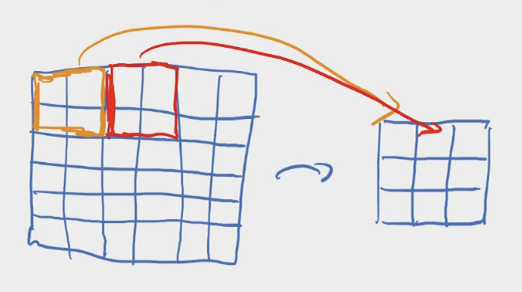
- Each unit only depends on all “closeby” inputs (eg. pixels
- Weights are reused (sparse)
- Convolution: weighted sum of nearby pixels
- Key idea: learn the filters
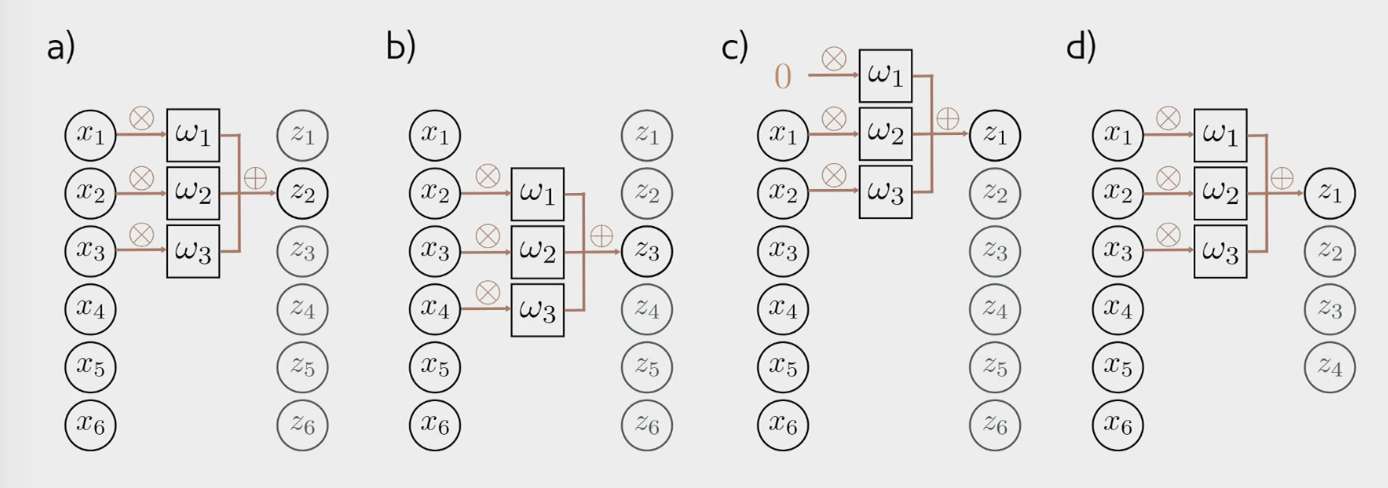 c: with padding, d: without padding
Ex.: highlights edges. double check
Stride: Skipping pixels in a convolutionary layers in regular steps
Computing output dimensions:
- Applying different filters (convoluting by tensor)
- To an image
- Padding
- Stride tensor with
The # of inputs affecting each unit grows with every hidden unit.
Pooling Layers (Subsampling)
- Aggregate neighboring entries
- Consider either the average or maximum value of a group of neighboring pixels
- Average is just another convolution
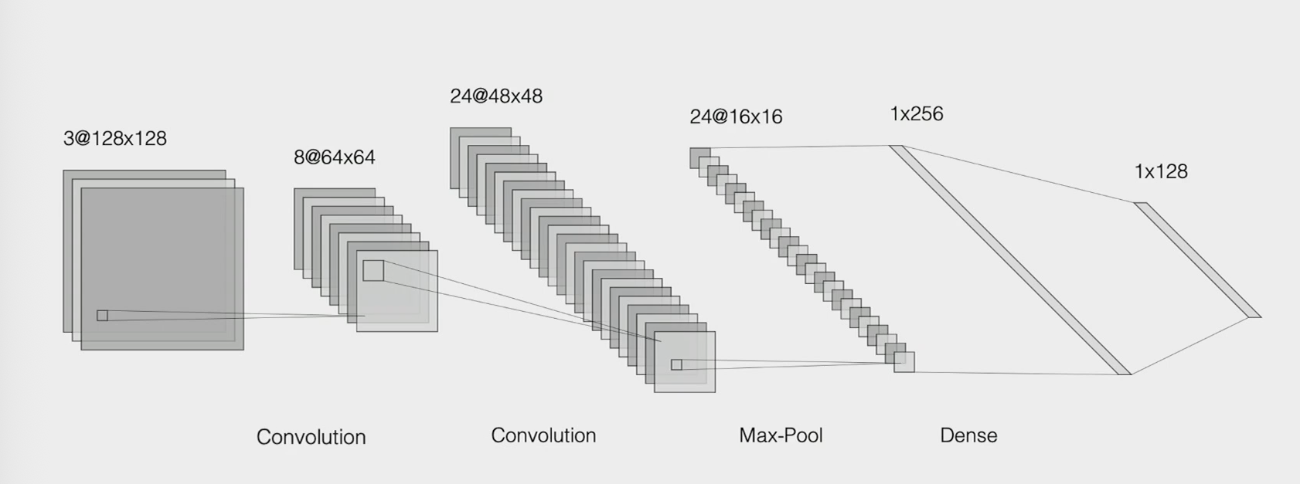 Common setup