4. 2-3 Trees
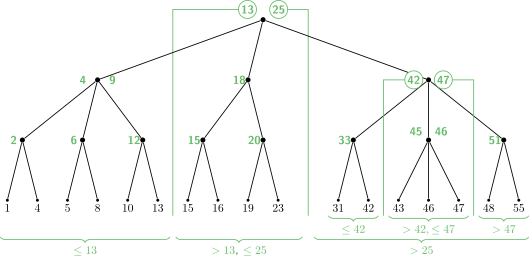
Problem: Binary search trees can become unbalanced, destroying access times.
2-3-Tree Rules
- All leaves are at the same depth.
- Keys within a node are ordered.
- Subtrees respect the BST property: for any key, all keys in the left subtree are smaller, and all keys in the right subtree are larger.
Find
How it works: Always compare the key of the element to the node. If the key is smaller, go the the left. If it is larger, go to the right.
Runtime: to since all leaves at same depth
Add
How it works:
- Run modified find to get the closest node
- Add element
- If the parent node now has more than 3 children, split it.
- Propagate upwards if necessary.
Why it works: 2-3-tree rules maintained.
Runtime
- for find
- to add element and split.
- for propagating b/c it involves at most all the ancestor nodes
Total:
Remove
How it works:
- Run find to get element
- Remove element
- If the node now has 1 child:
- A neighbor to the left or right has 3 children: adopt child of neighbor
- If a left or right neighbor has 2 children: merge child into neighbor. Propagate upwards if necessary
- No priority given in script. However, merging is computationally more expensive b/c it may involve propagation.
Why it works: 2-3-tree rules maintained.
Runtime
- for find
- to remove element and adopting/merging.
- for propagating b/c it involves at most all the ancestor nodes
Total: